


I Couldn't Fasten My Own Necklace at My Daughter's Engagement Dinner. So I Kept a Diary for the Twelve Weeks After.
Fourteen months on a GLP-1 for my blood sugar, every headline this year promising my joints would thank me — and a hand therapist in my dental chair who explained what the headlines left out.

A few things before you read on. I'm not a doctor. I'm a dental hygienist, three days a week, in Newcastle, New South Wales. Nothing here is a reason to start or stop anything your GP has put you on. And this isn't a miracle story — it's a diary, and diaries are mostly ordinary days.
I'm 58. Twenty-nine years of leaning over a chair with a scaler in my right hand and a mirror in my left. My hands started sending me the bill in my early fifties — the base of the thumb first, then the knuckles, then the knees from kneeling to adjust the chair. Two years ago my GP put me on one of the weekly GLP-1 injections for my blood sugar. It did exactly what she said it would. Nineteen kilos, over fourteen months. I bought a dress for my daughter's engagement dinner that I would not have tried on the year before.
And I'd read the headlines. Everyone had. The injections and knees. Cartilage on a scan. Fewer joint replacements. I'd sent them to my sister with a row of exclamation marks. So the dinner was supposed to be the night I felt like a different person from the neck down.
This is what actually happened, week by week. I wrote it down because I write everything down — twenty-nine years of patient notes does that to you.
The clasp.
Bec rang on Tuesday to say Josh had asked, and the dinner was booked for Saturday at the place on the harbour. I had the dress. I had my mother's chain, the fine gold one with the little spring-ring clasp I've been doing up since I was fifteen.
Standing at the wardrobe mirror, hands behind my neck, I couldn't do it. Not couldn't find it — couldn't make my thumb and finger pinch the ring open and hold it there. Third try, the chain went on the carpet. Pete did it up for me. He was kind about it, which was worse.
At the restaurant I got out of the booth with a hand flat on the table and the other on the back of the seat, and I saw Bec see it. Later, in the ladies', I went through my bag out of habit: the glucosamine I've taken every morning since I was 51, the turmeric I added at 54 because a rep at a conference swore by it, and the strip of ibuprofen, because there is always a strip.
Lighter than I've been since my thirties. Every article I'd saved on my phone said this was the year my joints would catch up. I sat on the closed lid for a minute and asked the question I've asked patients for three decades: if you're doing everything right, why is it still hurting?
Graham, 11:40. The patient who watched my hands.

Graham has been coming to me for eleven years. He's a hand therapist — an occupational therapist who does nothing but hands, wrists and fingers — and he sits in my chair twice a year and says almost nothing. On Tuesday he said something.
He'd watched me change my grip on the scaler three times in forty minutes. When I sat him up he said, apologetically, the way people do when they're about to be useful: "Can I ask you two things? Not as a patient."
The first: "How much of the weight you've lost was muscle?" I didn't know. He said most people on the injections don't, and that the small muscles of the hand and the big ones around the knee do the same job — they hold the joint lined up under load. In the drug's own trials, he said, roughly four in every ten of what came off wasn't fat at all — it was lean mass. Take appetite away for a year without asking the muscles to work, and the body spends some of them. Lighter, and less supported. He said the clinics are starting to say this out loud, and that women over fifty were losing muscle faster than men to begin with.
The second question is the one I've thought about every day since: "How long have you been taking joint pills that never leave your bloodstream?"
Seven years, I said. And then, because I'm a hygienist and I know exactly how it sounds when a patient says it: every morning, never missed, never felt a thing.
He explained it at the basin while he washed his hands, which is how I knew he wasn't selling anything. Cartilage has no blood supply. None — not in a knee, and not in the joints of your fingers, where it's about a millimetre thick and does the same job. It's a sealed cushion between two bones that drinks the fluid inside the joint like a sponge: every squeeze of a hand, every step on a stair, pushes old fluid out and pulls fresh fluid in. That fluid is the only way in.
So a capsule has two walls to clear. Absorption — and the body barely absorbs ordinary turmeric, so most of mine never got into my blood at all. Then delivery — getting back out of the blood, into the joint fluid, where the cartilage actually eats. Most of what does get absorbed never makes that jump. It circulates, and it leaves.
"You didn't fail the supplement," he said, drying his hands. "The supplement never made the jump." Then he booked his next appointment and left. He didn't tell me what to buy. He told me what to read.
I read the three studies that night, properly, the way Graham reads a hand X-ray. They're good work and I want to be fair to them.
2024, New England Journal of Medicine. STEP 9: 407 adults with obesity and knee osteoarthritis, 68 weeks. The semaglutide group lost far more weight than placebo and their knee-pain scores fell further. Real. March 2026, Cell Metabolism. The cartilage pictures everyone shared — mice, plus a 20-person human pilot. The clever part was the design: the untreated mice were made to lose exactly as much weight as the treated ones, and only the treated knees improved. June 2026, Regional Anesthesia & Pain Medicine. About five percent fewer knee replacements over eight years, on a drug taken indefinitely.
Every one of those researchers, asked directly, said the same thing: weight loss is still the most effective thing we know for arthritic knees, and the rest is early. None of it was tested on hands. None of it is a reason not to be on the medication if your GP wants you on it. It's a reason not to expect it to do a job it was never asked to do — and to look at what the treated knees were getting that the lighter, untreated ones weren't. It wasn't a number on a scale. It was something about how the cartilage cells were being fed.
Reading, then a decision. Then nothing, for a fortnight.
I read about the two walls the way I'd want a patient to read a treatment plan: what's the ingredient, what's the dose in the actual trials, and how does it get where it's going. My seven-year bottle failed on all three. A few hundred milligrams of glucosamine, a token turmeric, no absorption partner, pressed hard into a capsule.
What I went looking for, and found, was a formula built around the walls instead of around a price point: turmeric paired with a mushroom that helps the body absorb it, glucosamine at the dose the NIH trial used, chondroitin, MSM, vitamin D and calcium for the muscle-and-bone footnote. Two green-apple gummies with breakfast. Not a drug. Nothing to do with the injection — Dr Anand manages that, and I told her what I was adding.
I also did the thing Graham's first question was really about. The exercise physiologist at the clinic put me on protein at every meal and two twenty-minute band sessions a week. She was blunt: the injection changes what you eat, not what your muscles are asked to do.
Week one, honestly: nothing. Gummies at 6:50 with the coffee. Thumb still aching by the third patient. I wrote "nothing" in the margin and underlined it, because I know how many people stop here.
The Vegemite jar.
Small entry. Pete was in the shower, I wanted toast, the jar was new. I twisted the lid and it came off, and I stood there in the kitchen holding a jar lid like it was a trophy.
I'm not writing that down as a cure. My afternoons still ended with the thumb ache, and the stairs at the surgery still got a hand on the rail. But for two years the new-jar job has been Pete's, and I hadn't noticed how completely I'd handed it over until I didn't have to.
Ivy's bath.

My son's little one is two, and Sunday bath time at our place is the highlight of her week and, for the last couple of years, the low point of my knees. I kneel on the bath mat, she pours water on everything, and then I get up in stages — one hand on the rim, one on the towel rail, and a noise I didn't used to make.
This Sunday I knelt for the whole bath, sang the duck song twice, and stood up with one hand on the rim. No rail. No noise. Ivy didn't notice. Pete did.
The scale, for the record, had moved four hundred grams in six weeks. That was never the point, and I'm starting to understand why.
Nine patients, one grip.
A full Friday list, back to back. I noticed at about three o'clock that I hadn't swapped hands or wrapped the scaler handle in the elastic band I'd been using for grip since last winter. Nine patients. Same grip.
Graham was the eighth. He watched, as he does. When I sat him up he said, "You've stopped compensating." I said I'd read what he told me to read, and then some, and that I'd changed what I take and how I train. He nodded and asked about my daughter's wedding. That was the whole conversation. I still don't think he knows what brand I'm on, and I'd like to keep it that way.
The fitting.
Bec's first dress fitting. The seamstress asked us to bring the jewellery so she could see the neckline with it, and I'd brought Mum's chain in the little velvet bag.
Bec was on the plinth. I stood behind her, hands up behind her neck, and did up the spring-ring clasp on the first go. Then, because nobody was watching, I took off my own chain and put it back on. Both hands behind my head. Twenty seconds, maybe.
Twelve weeks. Not one entry in this diary says "lighter". Every one that matters says "reached" — the lid, the rim of the bath, the clasp. I'm not writing this because a gummy is a miracle. I'm writing it because for seven years I swallowed something every morning that never arrived, and a patient at my basin explained, in the time it takes to wash your hands, why.
The injection changed what I ate. It never changed what my joints were eating.
Let me be completely straight, because the internet is not. What I take now is a food supplement. It is not semaglutide, it does none of what the drug did in those trials, and nothing about it is a reason to start, stop or change a medication your doctor prescribed. If you're on a GLP-1, stay on it, and ask your GP about protein and strength work — that's footnote one, and it's theirs to handle with you.
What I changed is smaller and, for my hands and knees, turned out to matter more: I stopped swallowing things that never reached the joint, and started taking something built to.
Most of it never gets into you
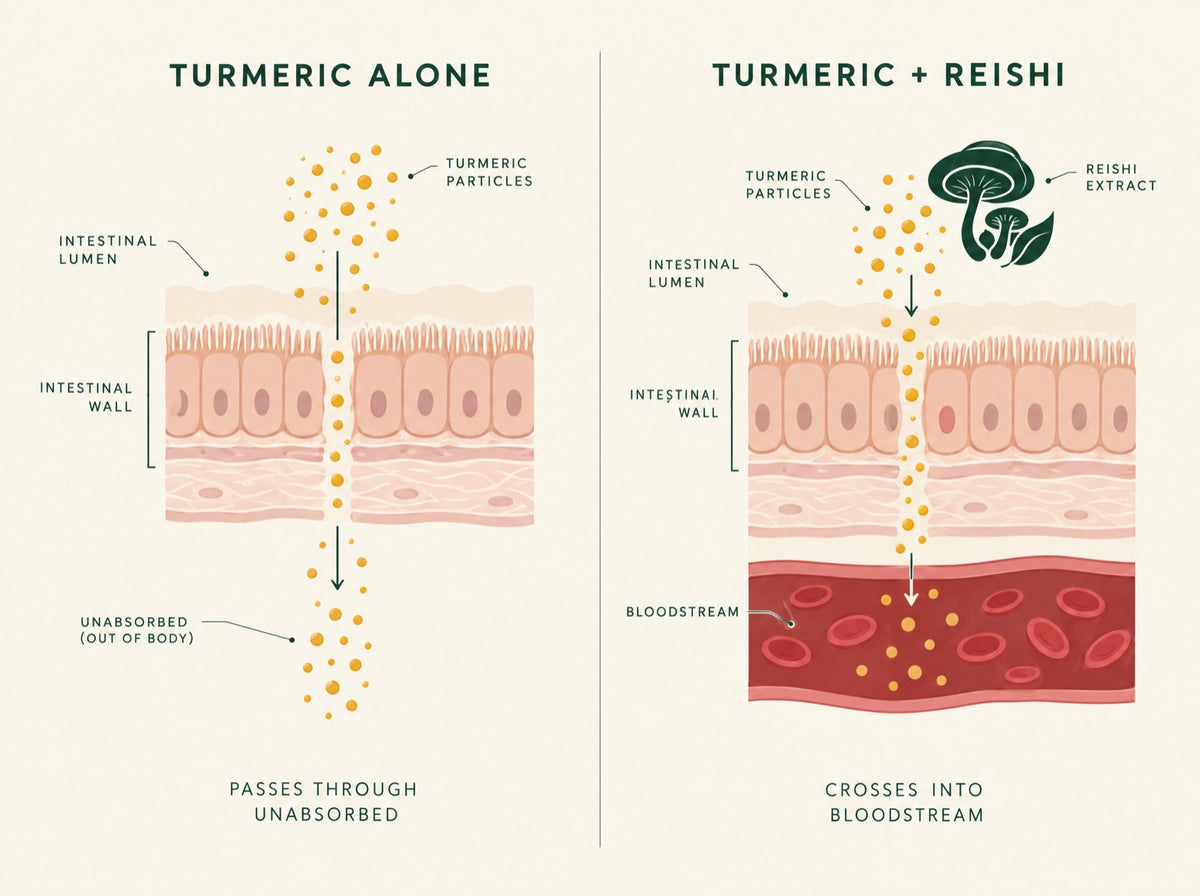
Turmeric is the comfort ingredient in nearly every joint formula on the shelf — including the one a rep talked me into at 54. On its own your body barely absorbs it; most passes straight through, unused. Seven years of my mornings, in other words.
Flexa pairs turmeric with Reishi, a functional mushroom shown to help the body take in up to 99× more of it than standard turmeric.* Same ingredient. Finally in a form that gets past the first wall.
And what gets in still has to make the jump
Clearing the gut is not the same as reaching the joint. Cartilage — in a knee or in the knuckle of a thumb — sits downstream of the joint fluid, not of a vein.
That's why dose and molecule size matter, and why a few hundred milligrams pressed into a hard capsule with no absorption partner was never going to reach the surface that's actually worn — however much weight you take off it, and however many jars your husband opens for you.
Into the joint fluid, at the wear surface, pumped deeper with every squeeze and every step. That's the whole job.
What's in it, line by line
I read medication lists for a living — every new patient, every recall. I read this one the same way before I ordered: ingredient, dose, and whether the dose is the one the trials actually used.
| Ingredient | Per daily serving | Why it's in there |
|---|---|---|
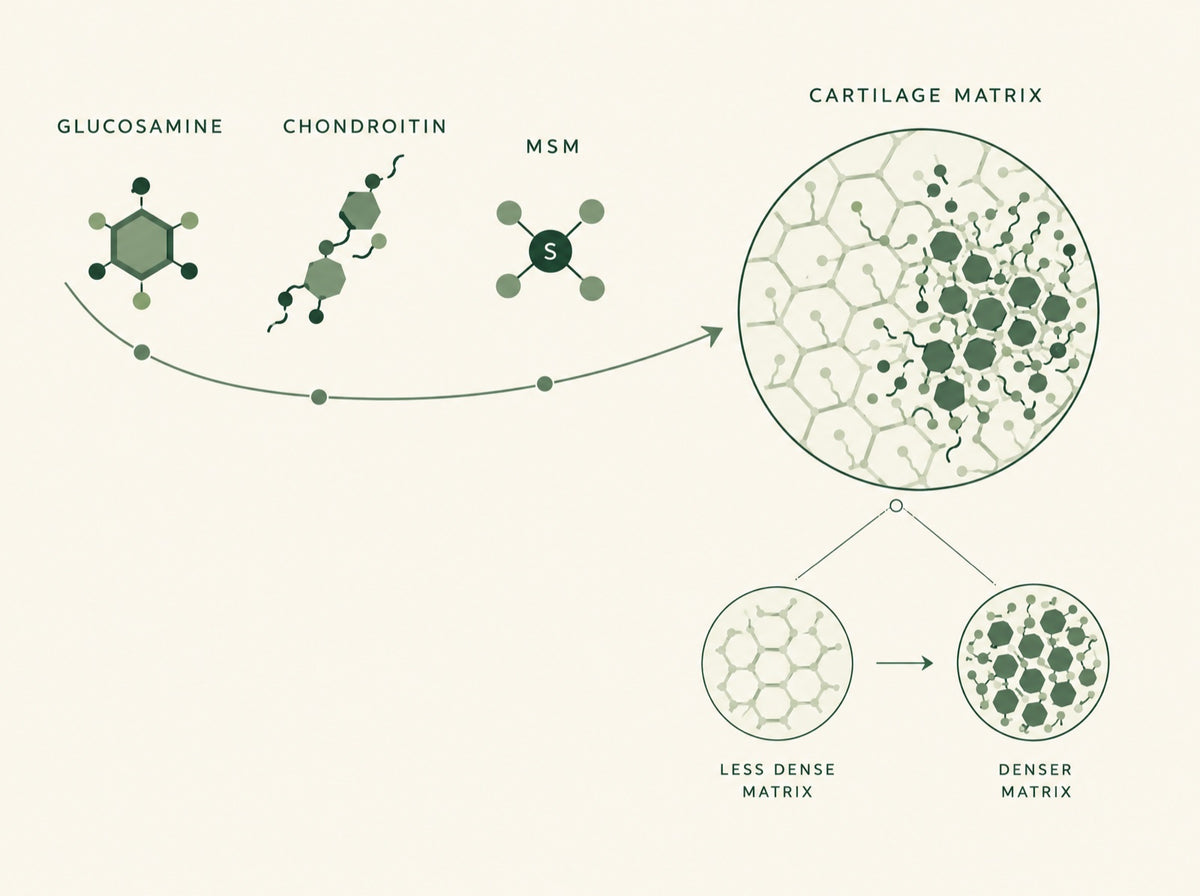
| Glucosamine | 1,500 mg | A building block of cartilage. This is the dose used in the NIH-funded GAIT trial — not the token amount on my old bottle. |
| Chondroitin | 800 mg | Paired with glucosamine in the trials; helps cartilage hold water, which is what makes a cushion a cushion. |
| MSM | 1,000 mg | A sulfur compound with its own placebo-controlled knee trials. |
| Turmeric | 200 mg | The comfort compound — reviewed across 16 trials and 1,810 adults. |
| Reishi | included | The absorption partner. This is the one most formulas leave out, and the reason the rest can get in at all. |
| Vitamin D3 | included | Contributes to normal muscle function and the maintenance of normal bones — the two things clinics now watch in people on GLP-1s, women especially. |
| Calcium | included | Contributes to the maintenance of normal bones. |
Run against a prescription drug. It held.
This is the part that ended my scepticism — I've sat through enough conference sessions to know a wellness claim from a trial.
Glucosamine and chondroitin were tested in GAIT — NIH-funded, 1,583 people, at 1,500 mg of glucosamine a day. The exact dose in Flexa. Then MOVES: 606 people, the same combination, head to head against celecoxib, a prescription anti-inflammatory, over six months. Comparable results.
That isn't marketing. That's a supplement combination run against a prescription drug in a randomised trial and not losing.
The studies referenced above
Real users, real results
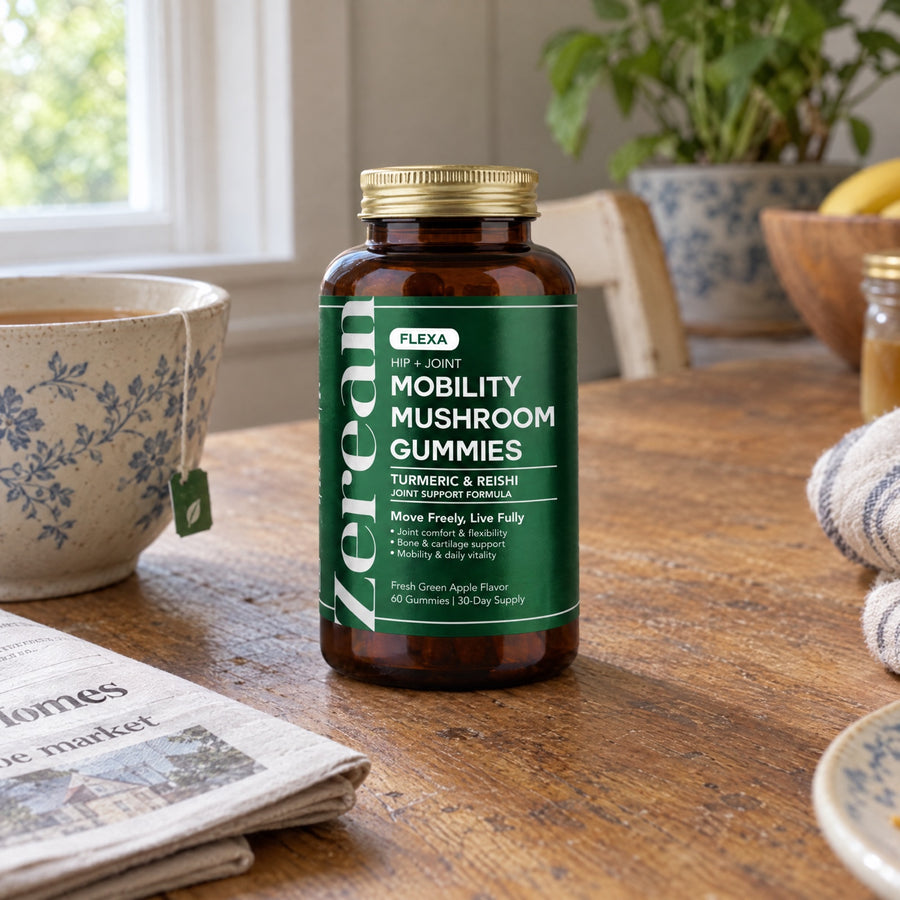
Your first bottle, 46% off
First order only, one per customer. Free shipping on orders over $80. Regular price $64.99.
4.7 on Trustpilot · GMP-Certified · Third-Party Tested
Judge it at ninety days. Not at three weeks.
You can't feel cartilage being fed in an afternoon. Glucosamine, chondroitin and MSM are raw material, not painkillers — delivered daily, doing quiet work over weeks. My own diary says "nothing" for a fortnight and underlines it. Most people who say a joint supplement "did nothing" stopped in week three, before anything had a chance to happen.
So don't judge this bottle overnight. Two gummies with breakfast, every day, and look back at the twelve-week mark: the jar lid, the bath rim, the clasp, whatever yours is. That's the honest test, and it's the only one we'd ask you to run.
Questions people ask before their first bottle
Flexa is a food supplement — glucosamine, chondroitin, MSM, turmeric, mushrooms, vitamin D3 and calcium. Most people take it with breakfast. But you're on a prescription, so ask your GP or pharmacist before adding anything, and never change your medication because of an article. Denise told her GP. We'd rather you did too.
The cartilage in a finger joint is built the same way as the cartilage in a knee and is fed the same way — from the joint fluid, not the blood. Flexa supplies the raw material cartilage is built from, in a form built to reach that fluid. It doesn't target one joint over another; it's what's in the fluid every joint drinks.
No. Those studies were of a prescription drug, and the cartilage findings are early — mice and a 20-person pilot. Flexa makes a different and much smaller claim: it supplies what cartilage is made of, in a form built to make the jump into the joint fluid. That's the only claim we make.
Almost certainly your old bottle had no absorption partner and no way into the joint fluid — so the ingredients were fine and they never arrived. That is the whole reason Reishi is in this formula, and why the glucosamine is at the trial dose rather than a token amount.
No, and we won't pretend otherwise. It supplies the material cartilage is built from. That's a slower, different thing than muting a signal — which is why the diary above says "nothing" for the first fortnight.
No. What you see is what you're charged, once. If you'd like it sent automatically you can choose that at checkout, and change or stop it whenever you like.